News
Latest News & Upcoming Events
The Global Seaweed Coalition is hiring a fundraising manager
The Global Seaweed Coalition (GSC) is looking for its new fundraising manager ! The fundraising manager will work under the supervision of the GSC co-founders to raise funds to support GSC’s operations, including funds to seed innovative seaweed projects through...
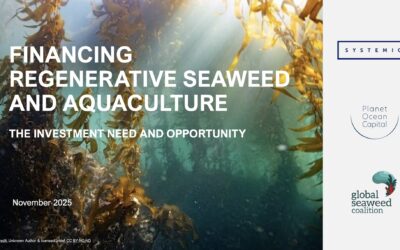
Financing Regenerative Seaweed & Bivalves Aquaculture: Launch Event
🗓️ Monday 1st December; 13.00 – 14.00 GMT Watch the replay here Join Systemiq, the Global Seaweed Coalition and Planet Ocean Capital to launch a new whitepaper: "Financing Regenerative Seaweed and Aquaculture: The Investment Need and Opportunity" ! 🔗 Register here...
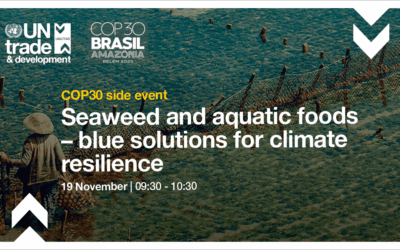
COP30 side event: Seaweed and aquatic foods – blue solutions for climate resilience
19 November 2025 09:30 - 10:30 hrs. Blue Zone, Thematic Room Location Belem, Brazil Seaweed and aquatic foods are emerging as powerful nature-based solutions to address the climate crisis, enhance food security, and support sustainable livelihoods. This event explores...
COP30 roundtable: Trade, climate, food security and development potential of seaweed aquaculture
18 November 2025 11:20 - 12:35 hrs. Auditorium A3, Agriculture and Science (Agrizone), Embrapa Amazônia Oriental Location Belém, Brazil Seaweed serves as a sustainable and nutritious food source, offering substantial environmental benefits such as carbon capture and...
Global Seaweed Coalition secures critical funding to continue its operations
The Global Seaweed Coalition (GSC) is proud to announce it has secured two years of funding to continue its operations, enabling GSC to maintain its role in promoting the safe and sustainable development of the global seaweed sector. This crucial support is provided...

A Seaweed Revolution Begins: United Nations Global Seaweed Initiative Officially Launched
New global platform unites countries and UN agencies to unlock seaweed’s potential for climate action, food security, and ocean sustainability A bold new chapter in ocean sustainability and climate action was written in New York on 23 September 2025, as the United...
Launch of the United Nations Global Seaweed Initiative (UNGSI)
UNGA 80 side event 6:15-7:30 pm EDT September 23, Conference Room 7, UN HQ, New York Background: Seaweed offers an array of benefits for people and the planet, including contributing to food and nutrition security in diverse ways, providing significant opportunities...
Seaweeds and Climate: Why do we need a UN Global Seaweed Initiative?
GSC Climate Week event 3:30-5:30 pm EDT, September 22, UNGC Boardroom, New-York Background: Seaweeds help mitigate climate change by absorbing CO2 and nutrients from the ocean, serving as a source material for bioplastics and potentially biofuels that reduce reliance...
Supporting seaweeds and their myriad contributions to advancing sustainable, inclusive, science- and evidence-based solutions for the 2030 Agenda and beyond
Madagascar, Indonesia, France, UN entities & Global Seaweed Coalition announce support for the creation of a UN Global Seaweed Initiative at the 3rd United Nations Ocean Conference, Nice, France
A coalition of governments, UN entities, and partners has announced the development of a United Nations Global Seaweed Initiative (UNGSI) — a collaborative platform to promote global efforts for safe and sustainable development of the seaweed sector supported by...
On Ubuntoo
thefishsite.com
Sri Lanka is positioning itself as an emerging force in the Indian Ocean seaweed economy following its participation at the seventh India International Seaweed Expo and Summit 2026, held at ICAR–Central Marine Fisheries Research Institute (CMFRI) in Kochi.
The event, recognised as one of the region’s largest seaweed-focused business and research gatherings, brought together international stakeholders from Brazil, Sri Lanka, the Netherlands, Sweden and other countries. Delegates representing Latin America, South Asia and Europe signalled strong interest in cross-border partnerships, technology transfer and the development of new market linkages.
According to a press release, Sri Lanka sees coordinated policy alignment, private investment, research–industry partnerships and regional trade collaboration as key pillars for growth. With these elements in place, the country aims to emerge as a diversified seaweed hub within the Indian Ocean corridor.
As global demand rises for sustainable marine biomass across food, agriculture, pharmaceuticals and climate-linked industries, Sri Lanka’s engagement at the expo underscores its intention to play an active role in shaping the region’s blue economy. The country is seeking to leverage growing international momentum around seaweed as a sustainable resource with applications in high-value product manufacturing.
A central feature of the summit was the Seaweed 2030 panel, an ambitious national roadmap designed to position India as a global leader in sustainable seaweed production, processing and value-added manufacturing. The two-day programme also facilitated knowledge exchange and collaboration among participating nations, reinforcing Kochi’s role within the global seaweed ecosystem.
The summit was jointly organised by the Indian Chamber of Commerce and ICAR–CMFRI. Sri Lanka’s participation highlights its strategic intent to expand its footprint in the sector, align with regional initiatives and strengthen its presence in international seaweed markets as the industry continues to scale globally.
Source : thefishsite.com
ft.lk
Sri Lanka is positioning itself as an emerging leader in the Indian Ocean seaweed economy following its participation at the 7th India International Seaweed Expo and Summit 2026 held at ICAR-CMFRI in Kochi, India.
Representing Sri Lanka and the Maldives as an international panelist, Seaweed Development Consultant Sivaram Kulendran highlighted the region’s growing potential to transition from small-scale seaweed initiatives into a structured, export-oriented industry. He underscored the strategic importance of developing sustainable seaweed value chains across the Indian Ocean, emphasizing collaboration, research, and private sector engagement.
Kulendran noted that Sri Lanka possesses favorable coastal conditions for seaweed cultivation and can leverage its geographic advantage to become a competitive player in the sector. He stressed that moving beyond pilot projects toward commercial-scale production will require coordinated policy support, investment in technology, and capacity building among coastal communities.
The expo brought together policymakers, scientists, entrepreneurs, and investors to discuss innovations, sustainability practices, and market opportunities within the global seaweed industry. Discussions focused on enhancing cultivation techniques, strengthening supply chains, and unlocking value-added opportunities in food, pharmaceuticals, cosmetics, and bio-based products.
Sri Lanka’s participation signaled its intent to align with regional partners and tap into the expanding global demand for seaweed-based products. The country aims to integrate seaweed farming into broader blue economy strategies, promoting livelihood development while ensuring environmental sustainability.
By engaging at international forums such as the India International Seaweed Expo, Sri Lanka is seeking to build strategic partnerships, attract technical expertise, and position itself as a hub for seaweed innovation in the Indian Ocean region. The initiative reflects a broader ambition to diversify exports and strengthen marine-based industries as part of long-term economic development planning.
Source : ft.lk
ft.lk
Sri Lanka’s extensive coastline, long valued for its natural beauty and marine resources, holds untapped potential beneath its waters through seaweed farming. The column highlights seaweed cultivation as an emerging agricultural opportunity capable of delivering significant economic, environmental, and social benefits to the country.
Seaweed is widely used across multiple industries, including food production, pharmaceuticals, cosmetics, fertilisers, and biofuels. Globally, demand for seaweed-based products continues to rise, driven by increasing interest in sustainable and plant-based alternatives. For Sri Lanka, entering this market offers an opportunity to diversify exports while strengthening coastal economies.
One of the key advantages of seaweed farming is its relatively low investment requirement compared to traditional agriculture and aquaculture. It does not require arable land, freshwater, or chemical fertilisers, making it particularly attractive for a country facing land constraints and climate-related agricultural challenges. Seaweed cultivation also has a short growth cycle, enabling multiple harvests within a year and providing faster returns for farmers.
Environmentally, seaweed farming contributes positively by absorbing carbon dioxide and excess nutrients from seawater, helping to mitigate ocean acidification and reduce marine pollution. It can enhance marine biodiversity by creating habitats for fish and other marine organisms. As a climate-resilient livelihood option, it offers coastal communities an alternative income stream while reducing pressure on overexploited fisheries.
The article notes that Sri Lanka’s coastal conditions are suitable for cultivating commercially valuable seaweed varieties. However, to unlock this potential, coordinated efforts are required. These include research and development, capacity building for coastal communities, access to quality seedlings, and the establishment of supply chains and processing facilities. Supportive policies, investment incentives, and public-private partnerships would further accelerate industry growth.
Developing a structured seaweed farming industry could contribute to rural employment, women’s economic participation, and foreign exchange earnings. By integrating sustainability with economic development, seaweed cultivation presents an opportunity to transform underutilised marine resources into a strategic growth sector. The column underscores that with proper planning and institutional backing, seaweed farming could become a valuable pillar of Sri Lanka’s blue economy.
Source : ft.lk
media-01.imu.nl
DLG Benelux has announced the launch of Seagriculture World, a new global conference formed through the merger of Seagriculture USA and Seagriculture Asia-Pacific. The inaugural edition of Seagriculture World will take place from 19–21 May 2026 in Bangkok, Thailand, positioning the event at the gateway to Asia, the world’s leading region for seaweed production.
The newly consolidated conference aims to bring together international stakeholders from across the seaweed value chain to foster collaboration, innovation, and industry growth. By uniting the previously separate regional events under one global platform, the organizer intends to create a stronger, more connected forum for knowledge exchange and business development.
Bangkok was selected as the host city due to its strategic location in Asia, a region that plays a central role in global seaweed cultivation and production. The event is expected to attract a diverse audience of industry leaders, researchers, investors, and policymakers, reflecting the expanding global interest in seaweed as a sustainable resource.
The conference program will feature expert speakers addressing a wide range of topics across the seaweed sector. Key focus areas include seaweed for feed and food applications, offshore cultivation, and biorefinery technologies. Additional discussions will explore innovation, commercialization, and sustainable practices that support the industry’s long-term development.
Seagriculture World builds on the established reputation of the Seagriculture conference series, which has previously hosted events in Europe, the United States, and the Asia-Pacific region. The merger into a single global event reflects the growing interconnectedness of the international seaweed industry and the need for a unified platform to address shared challenges and opportunities.
By convening stakeholders from across continents, Seagriculture World aims to strengthen partnerships, stimulate investment, and accelerate innovation in seaweed production and applications. The 2026 Bangkok conference marks the beginning of this new global chapter, with a focus on advancing sustainable growth and reinforcing the industry’s role in addressing food security, environmental sustainability, and bio-based innovation worldwide.
Source : media-01.imu.nl
Low Energy Kelp Provides Crop Yield Benefits with Breakthrough Results
Engineers have achieved a world record efficiency for solar cells made from antimony chalcogenide, an emerging photovoltaic material, marking a significant milestone in the development of next-generation solar technologies. Their findings were published in Nature Energy, where the team reported a certified efficiency of 10.7%, the highest independently verified performance for this material to date.
This achievement represents the first time antimony chalcogenide has been included in the international Solar Cell Efficiency Tables, which track record-setting photovoltaic results worldwide. Inclusion in these tables signals formal recognition of the material’s progress and growing potential within the global solar research community.
Antimony chalcogenide has attracted increasing attention as a promising alternative for photovoltaic applications due to its favorable material properties. Researchers have been working to enhance its performance and stability, aiming to position it as a competitive option alongside more established solar cell materials.
The newly certified efficiency demonstrates substantial improvements in device performance, underscoring the rapid advancements being made in this emerging field. By reaching 10.7% efficiency, the research team has set a new benchmark that could accelerate further innovation and investment in antimony chalcogenide-based solar technologies.
The record-setting result highlights the broader push within the renewable energy sector to identify cost-effective, scalable, and durable materials capable of supporting global decarbonization efforts. As researchers continue refining fabrication techniques and device architectures, antimony chalcogenide solar cells may play an increasingly important role in expanding the range of viable photovoltaic solutions available to the market.
Source : AZoCleantech
SAMS Scientists Hail "Phenomenal" Red Seaweed Breakthrough
Scientists in Oban, Scotland, have achieved what they describe as a significant breakthrough in the cultivation of the high-value red seaweed Palmaria palmata, commonly known as dulse. Researchers at the Scottish Association for Marine Science (SAMS) report that they have successfully developed a tank-based method for growing the species, achieving what they call “phenomenal” growth rates.
The work is being carried out under the FABRICS cultivation project, led by Dr Puja Kumari at SAMS. According to Dr Kumari, discussions around seaweed cultivation have traditionally focused on large kelp species that generate substantial biomass. However, she emphasised the need for greater research efforts to diversify seaweed farming, particularly by expanding the cultivation of red seaweeds in the region.
Red seaweed cultivation is considered important for broadening the species base of the seaweed industry and supporting its long-term resilience. While kelps dominate much of the commercial seaweed sector due to their size and productivity, species such as dulse are highly valued and offer additional economic and ecological opportunities.
The tank-based cultivation approach developed by the SAMS team represents a controlled alternative to traditional open-water farming. By refining techniques for growing Palmaria palmata in tanks, the researchers aim to overcome existing bottlenecks that have limited large-scale production of red seaweeds.
The reported growth performance marks a notable step forward for the sector, potentially enabling more reliable and scalable production of dulse. The breakthrough could help drive diversification within seaweed aquaculture and support broader efforts to expand red seaweed cultivation in Scotland and beyond.
Source : The Fish Site
SAMS Scientists Hail "Phenomenal" Red Seaweed Breakthrough
Scientists in Oban, Scotland, believe they have developed a successful tank-based method for growing the highly-valued red seaweed Palmaria palmata, commonly known as dulse.
Source : SAMS
Hatch Blue Presents the First Seaweed Guide for Latin America and the Caribbean
The Seaweed Insights platform covers areas such as St. Lucia, St. Vincent and the Grenadines, Grenada, Venezuela, Chile, and Brazil.
Source : We Are Aquaculture
Brazil’s Red Seaweed Revolution in Agricultural Bioinputs
In Santa Catarina, a rising red seaweed aquaculture sector is turning fresh coastal biomass into high-value biostimulants, positioning Brazil to develop a domestic alternative to imported products.
Source : The Fish Site
Notpla Rolls Out Seaweed-Coated Packaging Across 160 Dutch Restaurants
Notpla has partnered with Dutch quick-service restaurant (QSR) Kwalitaria to advance its seaweed-based coating, suitable for trays and containers, with logistics provided by packaging distributor Conpax.
Source : https://www.packaginginsights.com